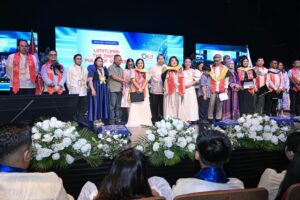
Reintegration must be part of the justice system, says DOJ Usec. Dato

For persons deprived of liberty (PDLs), serving a sentence should not mean losing the opportunity to rebuild their lives and return to their communities. Department of Justice (DOJ) Undersecretary Atty. Ian Norman E. Dato shared this perspective, highlighting the importance of rehabilitation alongside accountability.

Dato gave the statement in line with the recent Kulay, Kalinga, at Katarungan event held at the Bureau of Corrections in Muntinlupa City. He underscored that individuals who have earned the right to be released should be given the opportunity to rebuild their lives without unnecessary delays.
“Justice is not only about punishment but also about reintegration. The law allows a person to return to the world, make amends, and live a better life,” Dato said, adding that this also means ensuring that qualified PDLs are able to exercise their rights under the law, particularly when administrative processes may delay their release.
“Ultimately, when a person has earned the right to be released, the State must ensure that his freedom is not unnecessarily delayed,” he explained.
The law provides mechanisms that allow qualified individuals to return to their communities before completing their full sentences. Under the Indeterminate Sentence Law, he explained, courts generally impose minimum and maximum prison terms. Once a PDL has served the minimum term, the individual may be considered for parole, subject to legal requirements. Those sentenced to reclusion perpetua, however, are not eligible for parole.
Parole allows an individual to serve the remainder of the sentence under supervision in the community. Parolees must comply with the conditions of their release and remain under the supervision of a parole officer until their sentence expires or they are formally discharged by the Board. Violations may result in their return to prison.
The Bureau of Corrections, Board of Pardons and Parole, and Parole and Probation Administration have distinct roles in these processes, from keeping custody of national prisoners and computing time served to evaluating parole and executive clemency applications and supervising released individuals.
The activity resulted in the release of 44 PDLs, including one individual who was able to leave on the same day his documents were reviewed. The event also provided PDLs with access to activities and services, including painting sessions, a medical mission, and legal consultations. Volunteer lawyers from the DOJ, the National Telecommunications Commission, private law firms, and the Integrated Bar of the Philippines reviewed nearly 900 PDL records to determine eligibility for release.
For Dato, the opportunity to reintegrate into society is an important part of recognizing that individuals can take responsibility for their actions, make amends, and work toward better lives.